We will respond to you within three business days.
Better Data, Better AI, For Everyone, Forever
Submission Successful!
Thank you for reaching out to us. We have received your inquiry and are committed to responding within three working days. If you have any more questions in the meantime, feel free to contact our support team.
Hi there 😃
we are listening...
We will respond to you within three business days.

Submission Successful!
Thank you for reaching out to us. We have received your inquiry and are committed to responding within three working days. If you have any more questions in the meantime, feel free to contact our support team.
This website uses necessary cookies to ensure it functions properly, and tracking cookies to understand how you interact with it. The latter are only set with your consent.For more information, please visit our Privacy & Cookie for more information.
We use cookies!🍪
We use cookies to ensure basic functionality of the website and to improve your online experience. You can opt-in/out at any time for each category. For more details on cookies and other sensitive data, please read the full Privacy & Cookies
Strictly Necessary Cookies
These cookies are necessary for the operation of the website and cannot be switched off
Performance Cookies and Analytics
These cookies allow us to count visits and traffic sources so we can measure and improve the performance of our site
Targeting Cookies
These cookies are used to remember your choices and settings, maintain your preferences over time and recognize you when you return to our website
Worlds can be generated, and so can experience: JoinAI launches its Physical AI spatial generation platform at the Apsara Conference - News
news
Worlds can be generated, and so can experience: JoinAI launches its Physical AI spatial generation platform at the Apsara Conference
JoinAI
/ Sep 24, 2026
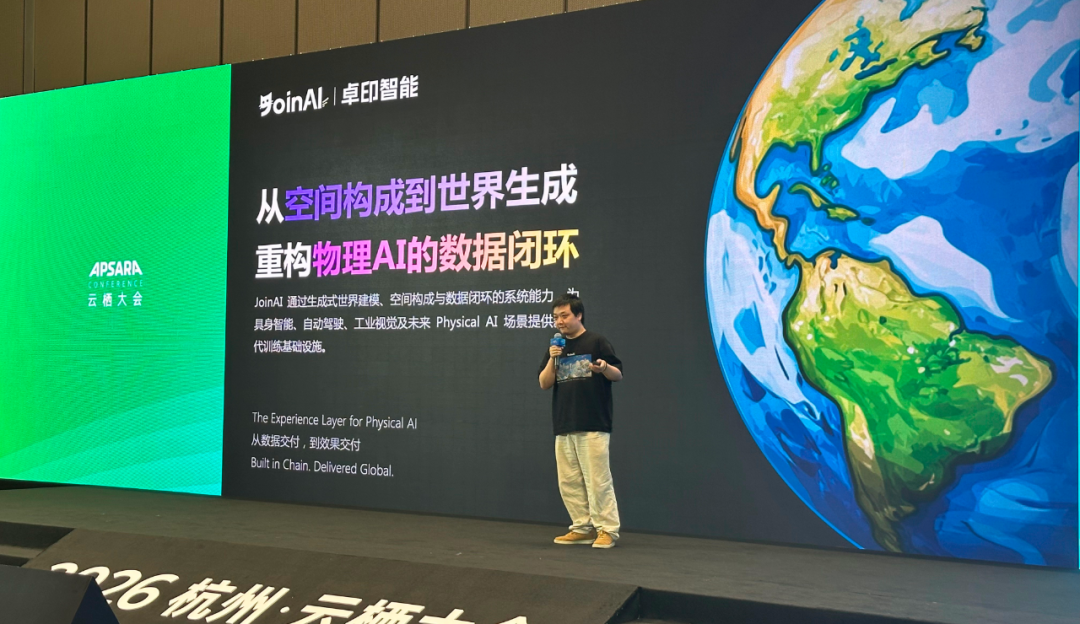
On September 24, during the 2026 Yunqi Conference, at the “Make Some Waves” product launch event hosted by Yunqi Academy, JoinAI Zhuoyin Intelligence founder and CEO Yu Kaiwen unveiled and demonstrated on site a spatial generation platform and related capabilities for Physical AI.
Starting from a single natural language instruction, a complete 3D space can be generated; objects in the space can continue to be added, deleted, and modified; and what is generated alongside the space is not only the final rendered image, but also depth, segmentation, point clouds, camera parameters, and other information needed for training.
What JoinAI aims to solve is not merely “how to generate a world,” but how to make the generated world further become experience that Physical AI can learn from.
Starting from a single Prompt, let space become a world that can continue to “grow.” In recent years, generative AI has become increasingly good at generating realistic images and videos. But for AI entering the physical world, “looking real” is far from enough.
What robots (embodied intelligence), autonomous driving, and more Physical AI systems truly need to understand is where objects are, what relationships they have with one another, how space is organized, and how the world changes when an agent interacts with the environment.
Therefore, compared with generating one or multiple final result images in batches, the spatial generation platform launched by JoinAI this time focuses more on another matter:
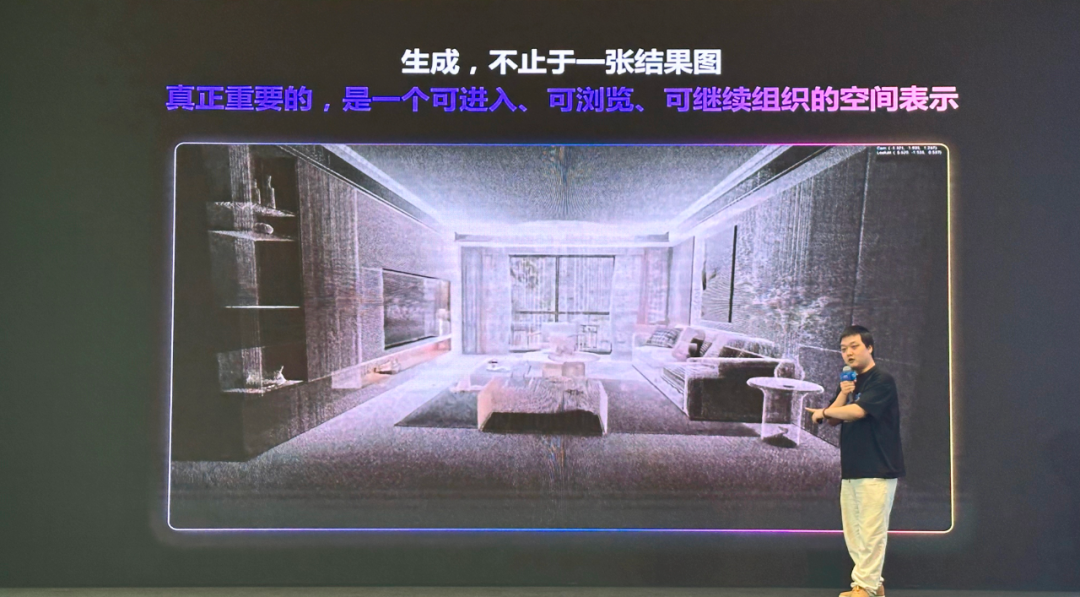
Generating a space that can be entered, edited, reorganized, and continue to produce training data.
In the on-site demo, users only need to describe the desired scene in natural language to directly enter spatial composition; the generated scene is not a fixed image, but a spatial representation that is “enterable, browsable, and can continue to be organized.”
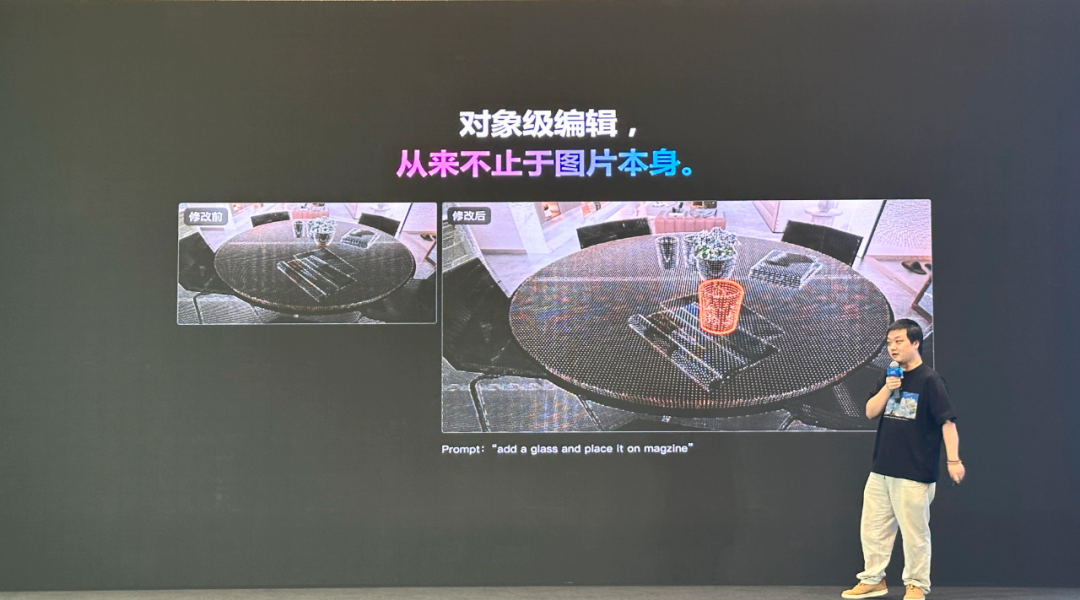
Objects in the space also become basic units that can be manipulated.
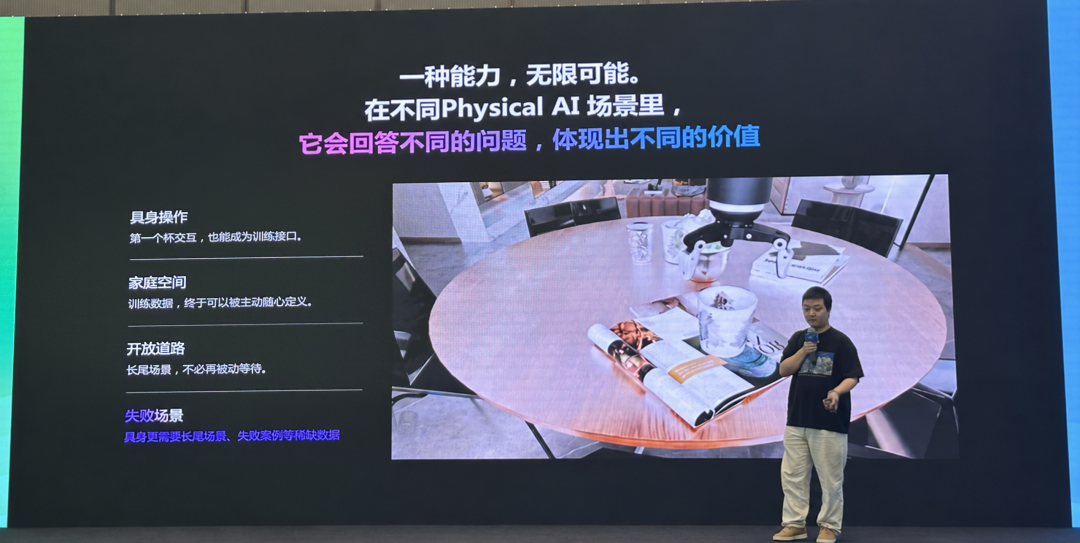
For example, an instruction like “place a glass on the magazine” can change the objects and their relationships in the scene, without needing to regenerate a result image that cannot be further manipulated.
What changes behind this is not only the method of spatial generation.
When objects, relationships, and environmental conditions in a space all become definable variables, data production also begins to move from “waiting for scenes to happen” to “actively defining what needs to happen.”
Generating an image is not the endpoint; what truly matters is what transmissible experience it can produce. For Physical AI, an editable space is still only a starting point. What can truly enter the training process is the visual, spatial, temporal, and interaction information contained in that space.
Therefore, in this demonstration, JoinAI further converts the generated space into images and videos, and simultaneously provides spatial and physical information including Depth, Segmentation, Point Cloud, Camera Parameters, etc.
This means that the same constructed world can further become a data source for different training tasks, rather than just a one-off visual generation result.
A world that can be learned from should not output only one kind of data.
This is also where JoinAI's spatial generation platform begins to connect with its existing products and technical capabilities. Within JoinAI's product system, spatial generation is not an isolated capability.
The scenario and data production and organization capabilities built around Simulaix, together with spatial composition, generative world modeling, and the Terraworld model, form a pathway from 'building worlds' to 'generating training experience.'
Spatial composition turns objects, relationships, and environments into variables that can be actively defined; generative world modeling further expands information across visual, spatial, and temporal dimensions; and data in different modalities ultimately enters downstream training and evaluation processes.
Worlds are built, experience is generated, models complete training and evaluation, and the results further influence what kind of data and scenes need to be built in the next round.
What JoinAI wants to build is not a one-off generation, but a continuously operating data closed loop.
What is truly scarce for Physical AI is the experience that 'needs to happen but has not yet happened,' which is why JoinAI points spatial generation toward Physical AI rather than stopping at generation itself.
Real-world data collection is inherently limited by cost, time, privacy, and the probability of a scenario occurring; traditional simulation, in turn, relies heavily on manual effort and preset rules, constantly facing trade-offs between realism and scalable expansion.
But for Physical AI, what truly determines the boundary of a model's capabilities is often precisely the situations that are unlikely to occur.
What truly determines the upper limit is unconventional cases.
For a robot that has already learned to grasp a cup normally, what it truly lacks next may not be more data on 'successfully picking up a cup.' What it may need is experience with the cup being occluded, its position changing, grasping failure, sudden environmental changes, or even unexpected collisions during execution.
Just as with autonomous driving before, normal roads occur every day, but the long-tail scenarios that truly determine a system's safety boundary cannot be reproduced in the real world at will according to training needs.
The problem facing Physical AI is not just whether there is enough data.The further question is:
What does the model not know how to do now? What does it need to experience next? Can these experiences be actively constructed?
In the product system demonstrated by JoinAI, home spaces can be reconstituted, objects can be added and moved, the same environment can yield different observations, and long-tail and failure scenarios can also be actively defined and further transformed into corresponding training data.
From embodied manipulation and home spaces to open roads and failure scenarios, spatial generation is therefore beginning to assume a new role:
Beyond regular scenarios, long-tail scenarios and unconventional cases no longer have to be passively awaited, and the experience needed for training can be actively defined.
From data delivery to outcome delivery: Why the Experience Layer?
In his on-site talk, Yu Kaiwen further discussed JoinAI’s assessment of the data problem in Physical AI and why the company defines its next phase as “The Experience Layer for Physical AI”.
“What Physical AI truly lacks is not just more data, but sufficiently rich experience that can be continuously iterated. What we want to do is turn the experience that originally could only be waited for in the real world into infrastructure that can be actively constructed, generated at scale, and continuously iterated based on model performance. This is what we call the Experience Layer.”
—Yu Kaiwen, Founder and CEO of JoinAI
For JoinAI, the Experience Layer is not a renaming of “spatial generation.”
Rather, it seeks to connect the capabilities that have gradually formed over the past few years into a single closed loop:
Real-world data and knowledge enter the system; spaces and scenarios can be actively constructed; world models further generate and expand the experience needed for training; and the results of training and evaluation feed back again into the data production process.
From this perspective, spatial generation is merely an entry point to the Experience Layer.
It addresses “how the world is constructed”; the further question is how these worlds become the training experience that models truly need, and how they continuously change according to model performance.
This also continues another thing JoinAI has always emphasized:
From data delivery to outcome delivery.
What Physical AI needs is not infinitely accumulated data, but data that can truly change model performance. When model capability becomes a feedback signal for data production, “what to generate” is no longer determined only by data supply, but begins to be determined by what the model needs to learn next.
From generating worlds to generating experience —
As AI moves from the world of language into the physical world, the data problem is changing along with it.
The core bottleneck is no longer simply “whether data exists,” but whether the world can be effectively constructed and represented, and whether a continuous data loop can be formed between models and the real world.
From spatial composition to generative world modeling;
from images and video to spatial, physical, and interaction information;
from data production to training, evaluation, and feedback.
What JoinAI is doing is taking the experience that Physical AI requires — once obtainable only passively in the real world — and making it into a layer of infrastructure that can be actively constructed, generated at scale, and continuously iterated based on model performance.